
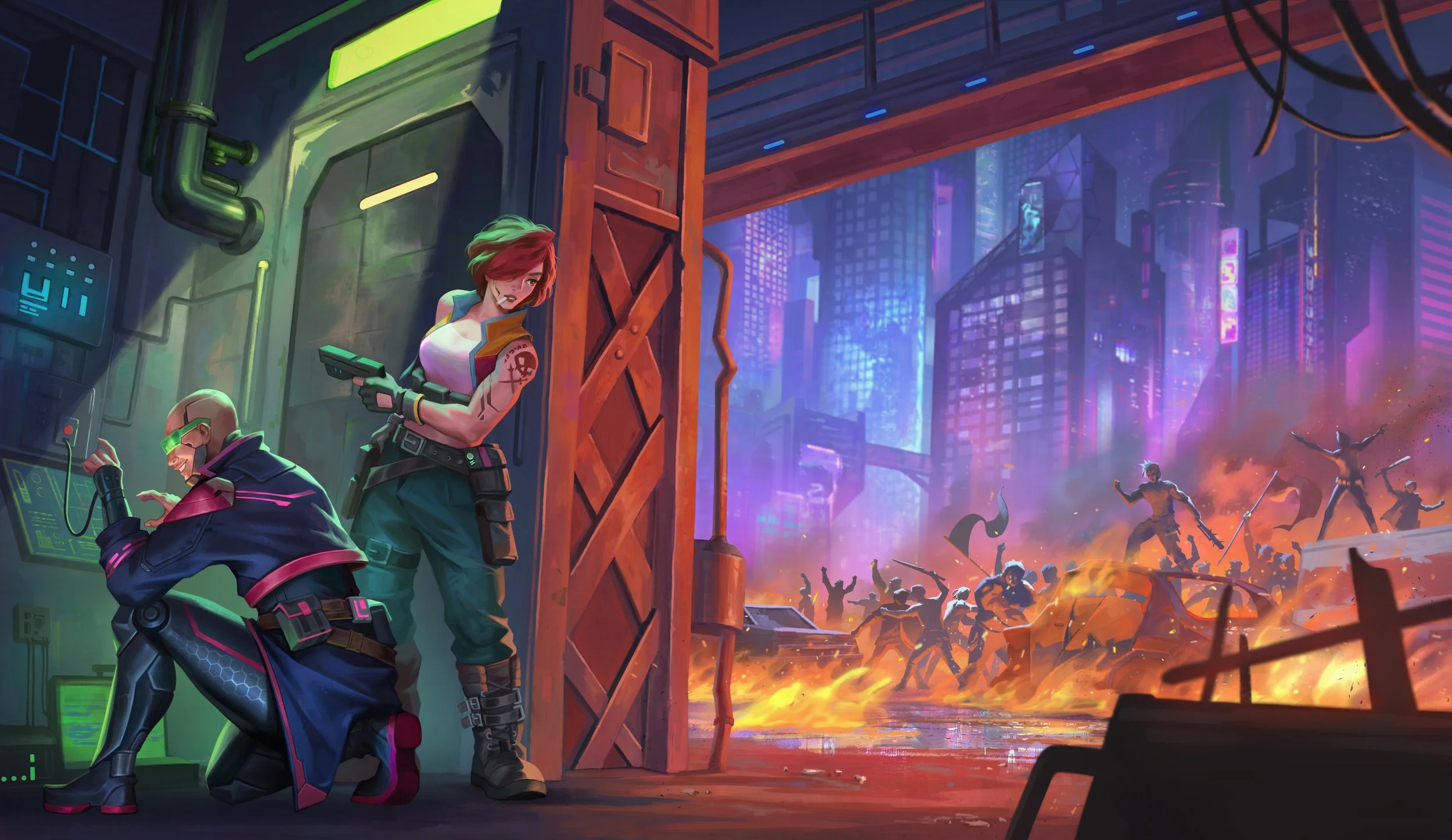

From the creator of Dusk City Outlaws and Spectaculars comes Neon City Outlaws, a tabletop roleplaying game where bands of daring criminals take on the corporate oligarchs of a dystopian cyberpunk city. Combining the heist structure of Dusk City Outlaws with the on-the-fly setting creation of Spectaculars, players and gamemasters will build their own futuristic city while planning crimes in an easy-to-learn, low-prep built for both campaign play and one-shots alike.
RESOURCES


The Core Game
Neon City Outlaws is a tabletop roleplaying game for 3-6 players, set in a sprawling cyberpunk city that you design during play. In this game, the players take on the roles of criminals on the outside of the law, collectively known as the Right Kind of People to those who run in outlaw circles. These criminals come together to form a crew, and take on a job, a criminal enterprise brokered to them by a third party that targets the nigh-immortal executives and their oppressive corporations. More than that, these characters are poised to strike back at the corporations and corrupt government in a way that everyday, law-abiding citizens can't. When dissidents are branded as criminals and speaking out against the corporate oligarchy is labeled as a crime, those who try to fight the corrupt system become members of the Right Kind of People. The only question is, once you're on the outside of the law, will you keep fighting tyranny, or just do what it takes to survive as an outlaw?
Neon City Outlaws builds off of the game structure of Dusk City Outlaws, integrating the setting creation tech from Spectaculars, to create a cyberpunk roleplaying game where you don't just change the world--you define it!
-
A tabletop roleplaying game with support for one-shots or campaign play.
The core resolution system for Neon City Outlaws is known as the 100AC System. This system was used in both Dusk City Outlaws and Spectaculars and a new iteration of the system, with expanded rules and more focus on character advancement, keeps Neon City Outlaws fast, exciting, and compelling.
The 100AC System combines percentile dice with d8 Advantage Dice and d10 Challenge Dice to give task resolution a broad spectrum of successes, failures, and additional benefits and consequences each time you roll the dice. When anyone attempts an action and the outcome is not guaranteed, you roll the dice. Each roll includes percentile dice (d100), and the number rolled on those dice is compared to a percentage chance of success; rolling equal to or lower than the chance of success number means that they succeeded in the action that was being attempted. Rolling higher than the percentage chance of success means the attempt failed.
Additional positive and negative circumstances surrounding the roll also add advantage dice (for positive circumstances) and challenge dice (for negative ones) to the roll. Up to four of each of these dice can be added to the roll, giving a broad spectrum of possible dice pools while still keeping the roll relatively uncomplicated. The result is a system that is fun, dynamic, and makes it easy on the person running the game to make things interesting with every die roll.
-
Each player takes on the role of a member of a crew of outlaws hired to pull off some criminal scheme. Players can choose from a variety of archetypes suited to different kinds of heists; grifters play con games, thieves are experts on breaking and entering, hackers excel at bending computers to their will, and so forth. Further, Neon City Outlaws embraces the transhuman evolution of technology, and players can augment their bodies with gene-splicing, cybernetics, and psionics, or eschew humanity entirely by playing a sentient artificial intelligence in a synthetic body. Detailed character advancement allows you to progress your intrinsic skills and perks every session.
One core setting element shared across all Neon City Outlaws settings is the concept of loading, or transferring the digitized mind of your character from one body to another. Advanced nanotechnology allows the mind to be stored in an electronic format, preserving backups of personalities in case of catastrophe. The upshot of this technology is that bodies can be treated more like tools, changed out as needed over the course of the job.
-
The rules for making your own setting and dozens of entries that guide you through the process of fleshing out your city are found in the game's setting book, a paired companion book that ties directly into the game's rules and scenarios. There are over 100 unique setting elements, each with its own entry in the setting book, that you can use to detail the corporations, districts, locations, characters, and other key parts of your cyberpunk setting.
Another element used by all Neon City Outlaws settings is the presence of the Network, a global telecommunications network with an immersive, virtual reality interface that connects directly to the nanomachines embedded in the user's brain. While, in some settings, scenes taking place in a VR network or while hacking corporate security feel like they require highly-specialized character choices to be viable, in Neon City Outlaws anyone can engage in virtual reality skullduggery thanks to avatar overlays.
Neon City Outlaws treats the virtual reality network just like any other districts in the physical world of the city. They might behave somewhat differently, but the ubiquity of the Network's use means that all characters have some basic proficiency in the virtual world, and can create or participate in scenes in network nodes just like they would in the physical districts of the city. When you enter the network, you manifest as an avatar of your choosing, and use the same overlay tech used for changing bodies to represent your presence in the virtual world.
-
While the first sparks of rebellion might fall from the actions of a single crew of outlaws, true change takes time, resources, and willpower. To represent the large impact that the crew has on the city and the fight against corporate oligarchy, Neon City Outlaws has a phase of play called simply the Revolution. During the Revolution, each player makes decisions on behalf of one of the city's outlaw factions, making city-changing moves that have repercussions far beyond a single job or crew.
Is your character a member of the city's vice broker cartel? Throw a huge soiree to attract the wealthy and then have undercover criminals harvest secrets from executive attendees. Perhaps you're a member of the city's underground media? Have your agents hijack a telecom station and sent out a pirate news broadcast exposing the dirty secrets of a corporation. Maybe instead you've aligned yourself with the band, a group of iconoclastic artists rebelling against the status quo? Stage a hit-and-run flash mob concert outside of a corporate headquarters to disrupt a press conference and get your revolutionary message out.
the products
Core Rulebook
This 260-page hardcover rulebook contains all of the rules you need to know to build characters for, play, and run Neon City Outlaws.
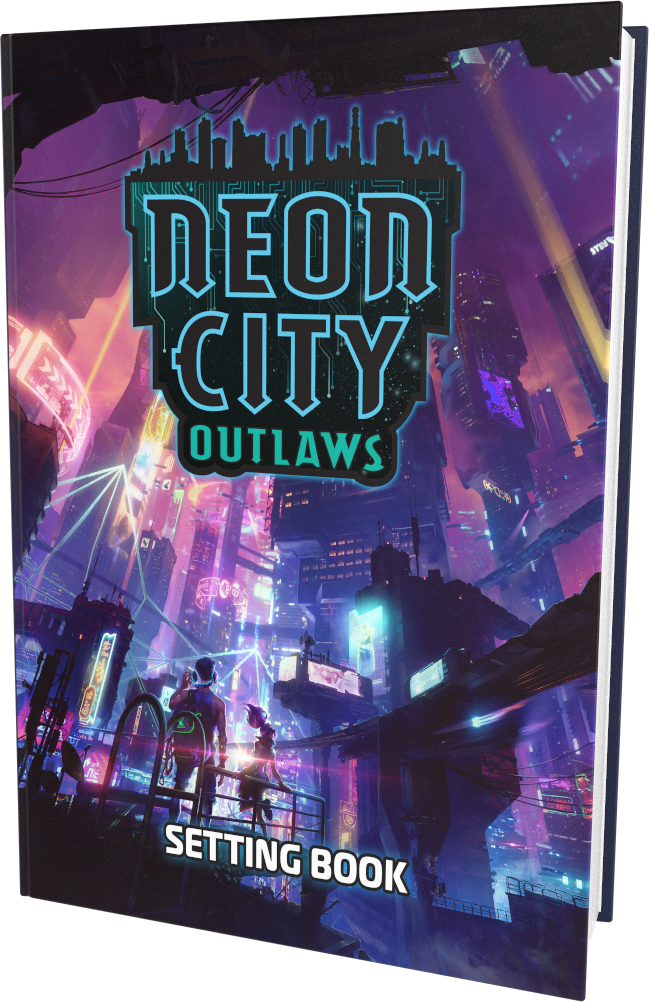
Setting Book
This 132-page softcover book contains everything your group needs to define essential elements of your cyberpunk city.
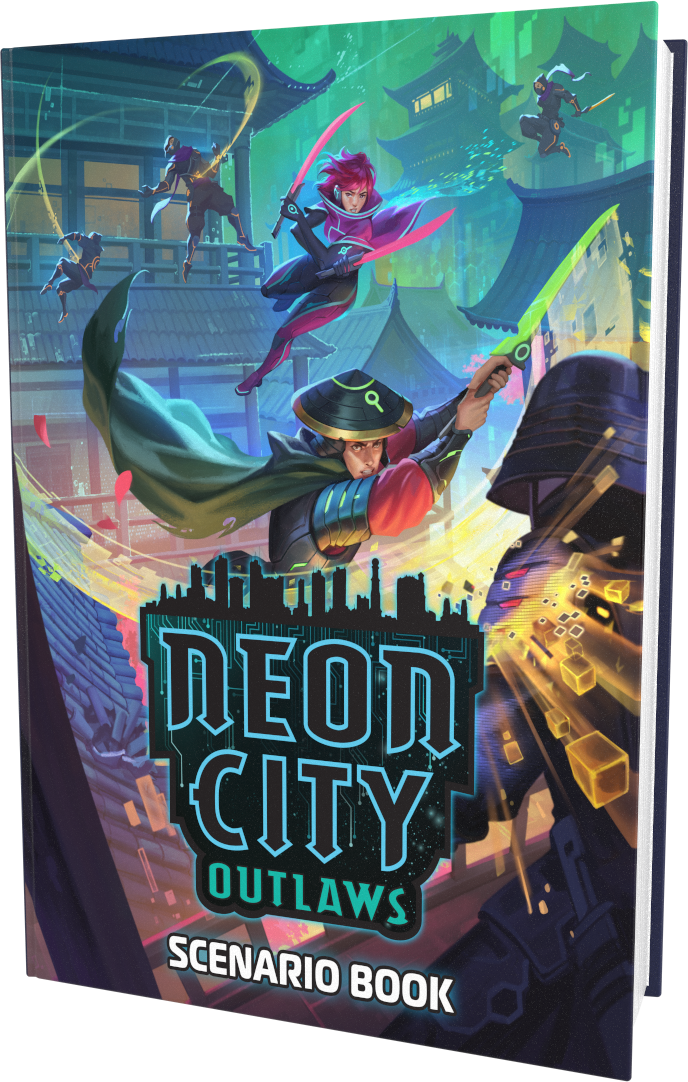
Scenario Book
This 96-page book contains 8 jobs for your criminal crew to play through, either as one-shots or together as an interconnected campaign.

Administrator’s Screen
This four-panel, full-color glossy-finished screen helps make the game easier to run while presenting players with a thematic image of a sprawling neon cityscape.
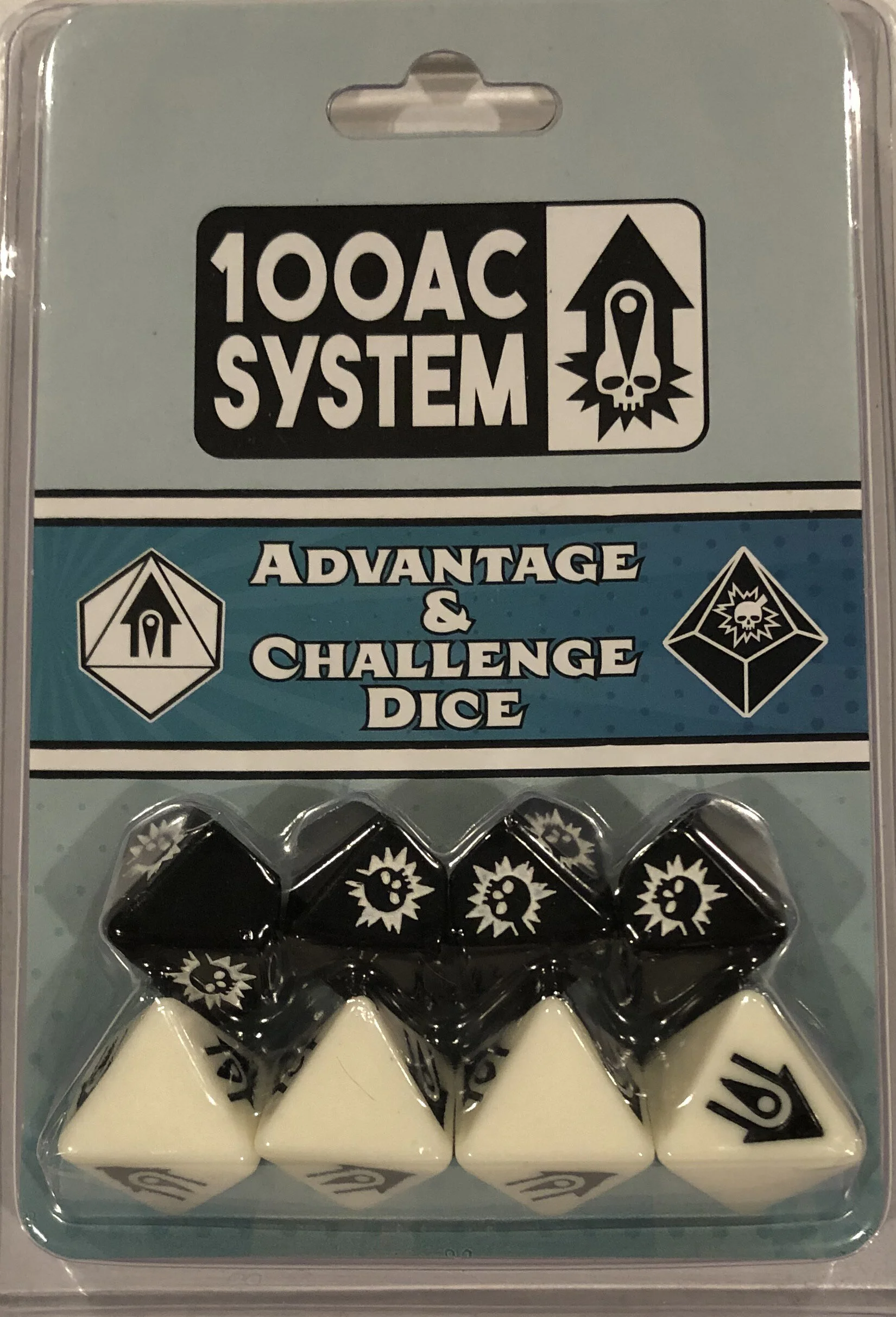
100AC System Dice Pack
This dice pack includes 4 advantage dice and 4 challenge dice, the standard suite of custom dice used by 100AC System games like Neon City Outlaws.
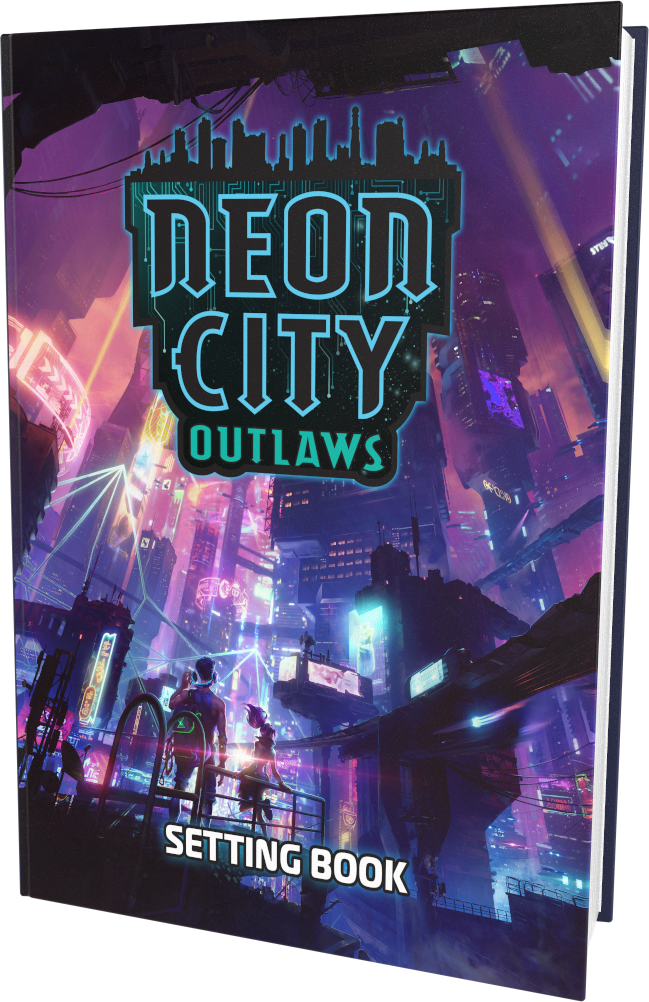
The neon city outlaws setting book
Following in the footsteps of Spectaculars, Neon City Outlaws doesn't come with a default setting to play in. Instead, it comes with tools (specifically, the softcover setting book) that help you build your own cyberpunk setting while you play. After answering a few questions up front to set the tone and get the general framework of your city established, you're ready to start playing. Throughout the game’s scenarios, the text will reference specific entries in the setting book (for example, a job might refer to D03: The Cultural Enclave, the entry for which is pictured in the image below), which lets you know to find the associated page in the setting book and fill it out, creating that setting element only when it is needed. Subsequently, you and your players can then refer back to these setting elements, reinforcing the themes and details you previously created
By the time your crew has played through a few jobs, you'll have a number of districts, non-player characters, and megacorporations fully fleshed out, and over time the unique elements of your dystopian city will become familiar to you and your players. Of course, that's just the start; these setting elements can shift and change over time, reacting to the decisions players make during the job. The setting book not only helps you establish your setting, but also track its evolution over the course of many sessions of play.
The Overlay System

Changing bodies is accomplished with the overlay system. Players' character sheets are divided down the middle, with the left side of the sheet representing elements of their minds and personalities, while the right side of the sheet represents their default bodies' physical attributes. When a player loads into a new body, they take an overlay sheet--a half-size character sheet--and place it on the right side of their character sheet. Overlay sheets representing bodies, referred to as shells in the game's setting, line up with the character sheet seamlessly, changing your physical statistics while leaving your mental stats intact.

When you enter the Network, you manifest as an avatar of your choosing, and use the same overlay tech used for changing bodies to represent your presence in the virtual world.
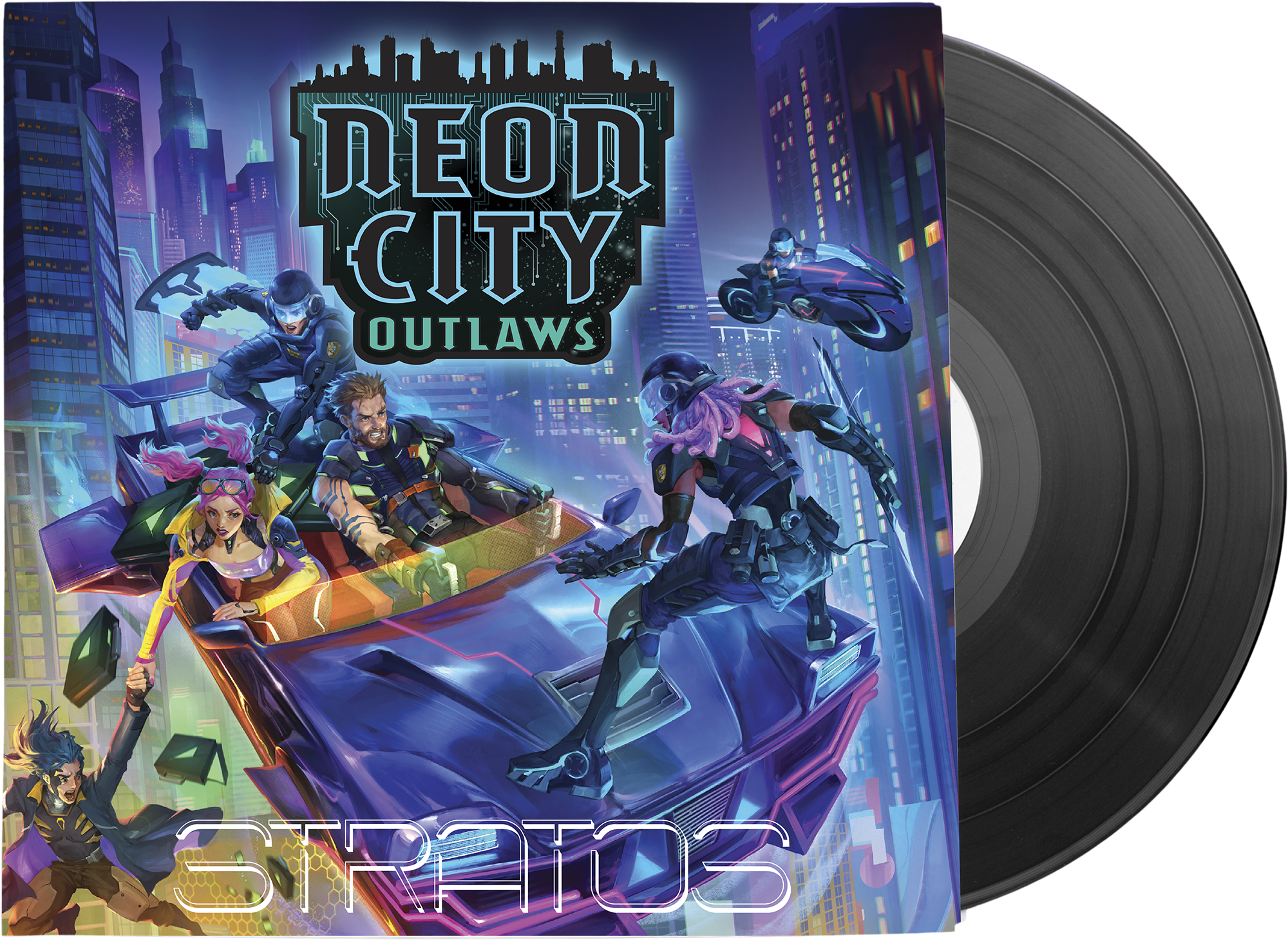
Official Soundtrack
Composed by Bryan “Stratos” Borgman and featuring 18 tracks designed to be used as at-the-table background music for your game, the official Neon City Outlaws Soundtrack from Bailey Records is the essential companion album for your cyberpunk heists. Each track was composed with a specific type of scene in mind, providing backing tracks for your planning scenes, conflict scenes, chase scenes, and even intro and outro music for you to signal the beginning and end of a session.
You can download the official soundtrack through DriveThruRPG.
Additionally, a limited print run of double vinyl albums will be produced alongside the physical edition of the roleplaying game, which can be preordered now through the PledgeManager site.